Monday, November 3, 2014

The Reason I Didn't Meet Nan Goldin

To write the words "Nan Goldin is a photographer" feels like such a lie. Not because she is not that, but because saying that's all she is feels lacking in depth, at least to me. There are some people who can capture an image, of a party, let's say. You see balloons, people dancing, and the swish of a skirt just fine. But there are some people who immerse you in their viewpoint, and looking at their images you hear music playing in the background, you feel the carpet under your feet, your tongue is sticky with the weight of one too many drinks, your nose stings with the scent of sweat and one too many cigarettes. Suddenly it's no longer a party, it's a moment immortalized, and you almost feel like you know everyone there. That's what Nan Goldin's work is to me.

I recently had the pleasure of seeing Nan Goldin speak at a photography conference held by the Lucie Foundation, whose mission is to honor master photographers as well as promote new artists.  I trekked through the rain and wind to arrive at 75 Varick Street's Splashlight Studios, arriving a half hour early so I could guarantee myself a seat. There was no way I would allow myself to miss it. 

James King backstage at the Karl Lagerfeld show, Paris, 1995
by Nan Goldin
I remember the first time I saw her work was in The New York Times, in a grouping of six photographs. The one that struck my eye was a photograph of the model James King, who was 16 at the time the picture was taken in 1995 and touring the world during the global Fashion Week seasons. It was originally part of the 1995 story "James is a Girl" by Jennifer Egan published in The New York Times Magazine that year. I think maybe I was in high school at the time I saw the reprint, seeing this 16-year-old girl painted up with her blonde hair in a big bun on top of her head, purple eyeshadow and dark red lips, a cigarette dangling from her hand. It was so much more than the photograph of a model. It was a portrait of youth abandoned for adulthood much too early. It was both beautiful and terrifying. I have never forgotten it.

When I got to college, I began studying photography. Any visual education exposes you to a variety of work, for both history and inspiration. When I saw Nan Goldin's work, I was done. If I could have stood up in my photographic history class and pointed at the screen and said "YES. THAT. HER. WHAT SHE'S DOING. THAT'S WHAT I WANT TO DO," then I would have done it. I remembered Goldin's name from that first image of James King I saw and I realized how much it stuck with me, too. There would be other photographers whose work I'd be interested in, of course, but I never felt as strongly about any of them as I did about her. Her book "The Ballad of Sexual Dependency" still has some of the most haunting, challenging, and provocative images I've ever seen, if not for the rawness and honesty of the actual content then also the angles and natural light she uses throughout. She photographed her friends and loved ones and the lives they lived together. The images weren't pretentious or celebratory or demeaning, they were just a record of life, stories told in another way. I resolved to do my best to tell my own stories through images the way Goldin did, and I still do today.

Goldin at the Lucie Foundation Lecture
Which brings us back to the lecture. In conversation with renowned culture writer Glenn O'Brien, Goldin, her hair still reddish and curly as it was in her earlier photographs, shared in her soft but forthright voice what brought her into photography, and then into the art world; her disdain for social media; and what her "process" is like. I remember her talking about the last item, confused by the man asking her the question, not to the point of not understanding him but rather thinking his question was pretentious. She didn't seek to photograph anything in particular; there wasn't really a "process." She just wanted to capture moments and take pictures of her friends. O'Brien called for more questions from the audience and my brain froze. I had admired this woman for so long and I couldn't think of a single question. I just wanted to sit there and listen to her talk, to absorb what she had to say. It felt like she had done this so many times before, given so many lectures and had maybe become bored with the process. And that's fair. Sometimes you can only talk so much about your own work before you start to feel like a blowhard.

At the end of the lecture, I of course wanted to meet her. But so did everybody else. This time, pushing through a crowd was not the problem. In fact, there were multiple times where she stood right in front of me, facing me, talking to someone at my side--at coat check, in the bathroom, in a gallery hallway. But I couldn't open my mouth (which, at this stage in my life, is for better or worse not usually a problem for me). I saw all these people going up to her--moms in their 60s wearing mom-ish mom clothes, photographers from small presses Nan had never heard of, people dropping names of others she vaguely knew--and they all looked so pathetic. She smiled and nodded cordially yet blankly and shook hands, like I'm sure she's done so many times before, all the while continuing to move forward toward a VIP area waiting for her. I couldn't open my mouth because I didn't want to be one of them, where nothing I would say would possibly affect her, nor would she ever remember me, because she'd heard it all and seen it all before. I couldn't bear to be meaningless to someone who had so deeply impacted me. I sort of just aimlessly wandered around the studio trying to get up the courage to say something but it didn't come until it was too late. I saw Nan walking down the hallway with a friend and this tiny little voice came out of me-- "Excuse me. Excuse me, I--" Nan didn't see me but her friend did, making eye contact with me. "I'd like to speak to--" motioning to Nan. But the friend, realizing what I wanted, then pretended not to see me and turned away, ushering her toward the closed doors of the VIP area.

I felt like nothing. My eyes watered and I quickly walked toward the elevator, praying it would come quickly before the tears fell out of my eyes in front of all these people. Outside, cold wind chilled my ears and my nose and I cried. I had met people whose work I loved before with no problem, but I couldn't do it this time. None of them were a part of my day to day experience of thinking about photography, none of them were the first name I cited when people asked me about my influences, none of their pictures gripped me over and over like Goldin's did. I was beyond starstruck, I was overwhelmed and overcome by just being in her presence. She was everything, the reason I had any vision at all of what I wanted my work to be or the direction I wanted it to go in, the ultimate inspiration. And how do you say that to someone? Especially without sounding like a total creepshow?

I don't know what Goldin would think of my photography. I don't know if she would love it or hate it. And I don't know even now if I could say anything to her worthwhile that she hasn't heard before. All I could probably do is say thank you, even though there's no way that even begins to cover it.

Friday, October 24, 2014

Flashback Friday: Mirror? Mirror.

Occasionally magazines go out of business and there's little to no trace of them left anywhere. While submitting some clips today, I realized a story I wanted to submit existed only as a document on my computer, not as a link online as it should have. I wrote the story, "Mirror? Mirror. Reflections on Cindy Sherman," for the arts magazine Idee Fixe (you'll see its Facebook page hasn't been updated in over two years, but it was in fact real!) once upon a time, when it still existed, about photographer Cindy Sherman's retrospective at the Museum of Modern Art here in Manhattan. I realized re-reading it today how proud of it I am, and because of that I want it to exist somewhere on the internet so I can share it for clips purposes. So here it is.

Mirror? Mirror.
Reflections on Cindy Sherman
By Elyssa Goodman

A sword-wielding female in a purposely ill-fitting bodysuit whose misshapen breasts hang like sad pillows; a proud dancer in a feathered tutu; a flower leotard-clad juggler in an awkward nude bodysuit; a lord-like male figure in burnt orange robes; and a stern brunette woman in a 1970s-era hostess gown. Each of the characters is completely different yet, somehow, completely the same. They are all Cindy Sherman.

“She just takes pictures of herself?”

A young chick says to her beau as they stroll behind me. She is wearing a leather jacket, skinny jeans, black boots and hoop earrings. Her hair hangs unnaturally straight on the sides of her head, the result of straightening one too many days in a row. The boy is tall and lanky, wearing a too-big baseball cap embroidered with something hip, the brim pushed up and away from his dark eyes.

I have never seen Cindys so big. Towering up the sharp white walls of New York’s Museum of Modern Art, the array of 24-foot high Cindy Shermans in a variety of costumes have been printed on immense sheets of PhotoTex adhesive fabric then stuck to the walls of the museum as a mural. It is the first time the mural, created in 2010, has appeared in the United States. It lines the entrance to Cindy Sherman’s career retrospective, on view at MoMA until June 11, 2012.

“I dunno. I guess?” He shrugs.

And, to be fair, upon first glance that is exactly what it looks like. It begs one to ask, what makes you so great, lady?
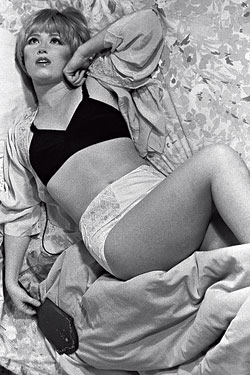
From Untitled Film Stills, 1977-1980
For 35 years, Sherman has been experimenting with identity, gender construction, and perception, developing characters for herself to portray then photographing herself as those personae. The characters are often based on existing female clichés—the young starlet, the aging socialite—though Sherman occasionally dabbles in male identity. She styles each character from head to toe, laboriously choosing just the right hair, makeup, clothing, jewelry, and facial features (in a recent documentary, she was shown to have a drawerful of prosthetic noses, among other prostheses and accoutrements, all meticulously catalogued in a filing cabinet-like system of drawers).

While she is perpetually the model, a factor some would say makes her work borderline narcissistic, she is never actually the subject of her photography, which negates the aforementioned criticism. For even when Sherman produces characters who pose in various stages of nudity, the exposed parts are always false ones. What Sherman is showing us in her photographs has nothing to do with her personality, her life, her anything. She is merely showing us the construction of identity as she sees it. The result is an adventure in the grotesquerie of human identity, in which we’re asked to question the choices we make in who we say to the world we are.

While she has no pretense of self-analysis, we never do lose the visual that the created person in the image is a figure she wears upon her body. In each image, whether she is a bedraggled 1960s art-film heroine (a la her majestic Untitled Film Stills series) or a Technicolor clown, we always recognize the tell-tale almond eyes and oval face that lets us know we are looking at a Cindy Sherman photograph. We are not asked to believe her characters are real, but rather that a similar likeness exists in the world. And by constructing each identity and wearing it upon herself, she is almost saying to us, “If I can create you, you must not be as real as you think you are.”

Because nearly all of Sherman’s work involves the portrayal of female tropes, she simultaneously comments on gender identity, calling into question the artifice of female presentation. Heavily lined eyes, skin colored orange to reflect fake tanning, sagging prosthetic breasts with absurdly large, pepperoni-like nipples, corsetry and lingerie of all kinds, high-fashion suiting, and much more all feature in Sherman’s portrayals of various types of women. As if to say, “Look at all the funny things women do and are. See how weird they look? Yet they still do these things, visually altering themselves for approval. Why?” Her goal is less to answer the question than to call it into the collective consciousness—why does the issue exist at all?

It’s clear Sherman takes great risk in exploring these themes decade after decade. Not only could it come across as ‘shtick’ by now, but a typical audience isn’t usually too comfortable with having its morals and identity questioned, certainly not on as regular a basis as Sherman does. Developing her work solidly, though perhaps not purposely, in the height of the second-wave feminist movement, Sherman’s work could have easily gotten lost in the shuffle of feminist art and critique the era produced. Her inquisitiveness and thereby her work in general could have easily gotten stale ages ago, resulting in indifference, but Sherman continued, and still does continue, to find new ways to explore identity and captivate her audience. Risking an oversaturated market of feminist-related work, indifference, and ‘shtick’ criticism, she has by now probably earned herself the equivalent of several Ph.D.s in identity studies. Not to mention a nuanced body of work that continually challenges visual and psychic perception.

Sherman used herself as a vehicle for analysis beginning while she was a student at Buffalo State College in upstate New York. One project, displayed at the MoMA retrospective, was a stop-motion film entitled “Doll Clothes” from 1975. In it, Sherman made a photo cutout of herself into a paper doll and used it to tell a story of identity through the clothing the doll donned. The rest of her career has essentially been a growth and re-imagining of the ideas initially explored there.
Toward the beginning of the exhibition, a frame full of small, hand colored black and white photographs show the artist transitioning from one character—a bespectacled, short-haired woman in a flannel shirt, her face wiped clean—to another—a 1970s cabaret glamazon complete with facial stars, dark lipstick, short, windswept hair and a dark choker—by changing just one facial feature or accessory in each photograph. We see her beginning the search, trying to understand what makes two people so completely different but still so closely linked.

Not long after this particular series was completed, Sherman began working on her aforementioned, groundbreaking work Untitled Film Stills (1977-1980), also on display at MoMA. In this black and white film series, Sherman takes on 1960s B-movie and art-film heroines, from the barely-dressed bombshell to the mad housewife to the stern and ambitious career girl. All are artfully orchestrated not just with Sherman’s signature self-styling but with camera angles befitting the project’s title. She is the director of films that do not exist. Each photograph seems vaguely familiar and upon first glance may even invite the viewer to guess what films are being duplicated. In actuality, each image is an amalgam of cultural detritus, a view of women so consistently portrayed that it’s embedded in our visual consciousness and thereby instantly recognizable. Sherman asks us to recognize this, placing us in the image while simultaneously checking us out of it (in some of the photographs we can even see her pressing the remote shutter on her camera).

These are factors that have been present throughout Sherman’s work since the Film Stills series. As Sherman began experimenting with color film and later digital color photography, the ideas have gotten bigger and richer, leading her to experiment with an added layer of reality the vibrancy of color provides. Also on display at MoMA is her ‘Centerfolds’ series from 1981, commissioned by Artforum magazine. ‘Centerfolds’ was completed not long after the Untitled Film Stills and is an all-color series playing with an alternate idea of women as centerfolds in men’s magazines. Instead of oozing sex, excitement, and arousal, Sherman’s centerfolds are pained, nervous, anxious, worried and pensive, all brought more vigorously, and unsettlingly, to life in color.

From Centerfolds, 1981
In 2008, as Sherman herself began to approach middle age, her experimentation with identity took on a new direction as she created a series of aging society matrons. Produced at the height of the economic bust in the United States, the formality and elegance with which these women lived their lives had all but disappeared, and they were left living as mere relics of time gone by. Sherman assembled their identities in regal satin or sequined ball gowns, standing against lush backdrops. Wrinkled and coiffed, tucked and pulled (or all four), these characters had done their best to keep up with the changing times but hadn’t succeeded. Considered a recent triumph, the series suggests the ease with which not just older generations but older women are tossed aside in favor of the new and fresh, how youth and beauty seem to be all that matters.
Sherman’s area of artistic study is neverending. While some have attempted such gender and identity studies, there are few, if any, artists who bring the ideas to fruition as clearly as she does. And as long as there are people, there will be people for Sherman to analyze in her work, be they Hollywood wannabes, society matrons, country singers, high fashion glamazons, starlets, clowns, pin-ups, corpses, pop stars, ingénues, or even artists.

Saturday, October 18, 2014

Model to Monument

I swear, if I don't have a set time I have to be somewhere, I will just keep walking forever. I've found that, living in New York, this is very much a luxury. No place to be for an entire day? I honestly can't remember the last time that happened. I like to walk for exercise as well as transportation, too. One of my favorite walks is up the East River, but waking up one morning and gossiping via text with AS led us to want to walk together. Bored of my typical jaunt to Randall's Island, I headed across town and met her on the Upper West Side, putting our walk in her hands.

Almost instantly, my own neighborhood walk was put to shame. Walking down the Hudson River, a lush navy blue under a cloudless sky in the crisp autumn air, we discussed Beyoncé Feminism and what makes someone a douchebag. The skyline of Jersey stood to our left and water sloshed against the piers. We had made the right decision to come out today. We passed sailboats, sculptures, architecturally unusual benches and seating spots, and a public art park that is a collaboration between the Art Students League of New York and NYC Parks.

The public art installation, called Model to Monument (or M2M), extends from 59th Street to 72nd Street. For four years, there have been a number of different sculptures by student artists throughout the park, each year bringing in a new work by a new artist. Students are chosen to produce their works at the end of each year and trained in producing art for public spaces. This is the fourth year of the process, and next year will be the last. These particular installations--which included everything from twisted mermaid forms to a giant hug to warped metal to a giant swing made out of translucent colored sheets and metal-- will be on view until May 2015.

Take a look at some of the installations here (please forgive the quality, they were taken with my iPhone) but, more importantly, go see them for yourself before they're gone.


Friday, October 3, 2014

Miss Manhattan Presents: An Evening with James Wolcott

If you weren't already aware, I'm excited to be hosting renowned cultural critic James Wolcott at The Miss Manhattan Non-Fiction Reading on Monday, October 6. This is how the event came to be.

A memoir about living through the grunge of 1970s? Sign me the hell up.

That's what I thought the first time I saw James Wolcott's memoir Lucking Out on the "Notable Non-Fiction" table at McNally Jackson. The cover was a grimy black and white photograph of one of New York's iconic bridges, tagged with the subtitle 'My Life Getting Down and Semi-Dirty in the Seventies' in grungy, typewriter-esque font.

According to the back cover, Wolcott dropped out of college and arrived in New York with little else besides the money in his pocket and a letter of reference from Norman Mailer.

I knew Wolcott for his work as a critic at culturally highbrow publications like Vanity Fair, The New Yorker and Harper's, yet had no idea he began as a gutter punk, so to speak, just like the rest of us.

Reading Lucking Out gave me hope to know that one might be able to struggle in the depths of New York as a young person--not arriving a privileged son or daughter of American royalty or whatever its equivalent might be and bearing the fruits of nepotism and similar nepotic pursuits--and still end up not only a working writer, but a culturally relevant one; in other words, one could end up as James Wolcott.

As soon as I finished the book, I knew I had to reach out to him, to say thank you for helping me know that at the very least I was moving in the right direction and that I wasn't going to drown in a see of my own hopeful metaphors. Seeing via Twitter that he was still located in New York, I decided I would make it my mission to meet him and talk to him about his work. I did my best to show that I wasn't some psychopathic non-fiction fangirl or other frightening specimen of literary junkie and said hello via Twitter. I would love to send you an email about your book.

Miraculously, he responded with his email address and I wrote--I would love to get you a cup of coffee sometime. I included a link to my writing portfolio to show for further anti-psychopathic evidence, just in case.

To be completely honest, I don't know where I find the balls to do things like this. I guess I just always follow my mother's advice: The worst thing anyone can ever tell you is no. Or not respond. Or say 'Excuse me, small, irrelevant writer person! How dare you contact me with nothing but a few internet articles to your name and nary a print feature to show for anything! I am [INSERT PRESTIGIOUS WRITER NAME] here and I should hardly be wasting my time writing to you let alone extracting the length of actual minutes to meet with you from my very busy and important day. GOODBYE.'

To be fair, the latter's never happened, though it's always something that sticks in my brain as a possibility, as if I live in some sort of 1950s-style magazine publishing drama about a young girl who comes to the city with publishing stars in her eyes. I do often fantasize about being Joan Didion, who found a similar fate being recruited to Vogue fresh out of college. But I digress.

Needless to say, this certainly did not happen with Mr. Wolcott. He wrote back. He said he'd be happy to meet with me. After about four months or so of scheduling and rescheduling dates and times, we were to have lunch on the Upper West Side on an April afternoon. I looked forward to it all week, mentally compiling the sorts of questions I'd ask. And what would I wear? I worried that I would laugh really loud, which I do all the time, especially when I'm nervous. What sort of food would I order? How would James Wolcott feel about me ordering a thick, juicy burger? Was I better off on the chic, dainty salad route? The day of, I felt my heart pounding in my chest as I arrived at the restaurant. I was early, saw him enter, and went up to offer my hand which, to my relief, was not sweating profusely.

Rereading this now, I fully acknowledge what an super-nerd I am. But if you met someone who is at the top of the field to which you yourself aspire, I'm sure you'd feel exactly the same. So just own it, and you'll be fine.

To my (further) relief, the conversation went smoothly. We talked about television, writing, his work at Vanity Fair, dance, photography, and a multitude of other subjects, seamlessly bouncing from one to another. I ordered a Cobb salad and a Diet Coke. He ordered the burger. He was a human, just like me, and very funny at that. In a moment of supreme nerdery, I asked him to sign my book; in it, he wrote 'Forward Ho!' urging me, in pioneer slang, to keep going with my career. (I told my friend Ben about this later, to which he joked, 'James Wolcott called you a ho?' NO, BEN. Though what a story that would have been, no?)

I also spoke about my reading series (The Miss Manhattan Non-Fiction Reading Series, if you are not acquainted!) and without being prompted, he said, "You know I'm a very good reader!" Well, I said, I would love to have you! Eventually, we nailed down a date and now, I'm excited to say, if you haven't seen already, on Monday, October 6 at 7:45pm at Niagara Bar in the East Village (112 Avenue A at 7th Street) I will be hosting a special Miss Manhattan Non-Fiction Reading Series event, An Evening with James Wolcott. Mr. Wolcott, now a 2014 PEN/Diamonstein-Spielvogel Award Winner for the Art of the Essay, will be reading a few of his non-fiction pieces, discussing his writing process for each of them, followed by a Q&A with me and then with the audience (a little bit James Lipton-style, a la Inside the Actor's Studio, if you will).

There's more information here. I hope you will be able to join me for this very special event! Feel free to reach out with any questions or comments, and please see below for a bit of Mr. Wolcott's biography.

--

James Wolcott won the 2014 PEN/Diamonstein-Spielvogel Award for the Art of the Essay for his book, Critical Mass, a collection of his cultural criticism from publications like Vanity Fair, The New Yorker, Harper's Magazine, and many others. He has been called a "soulful cultural sentry" and "among the last of the great, garrulous, generalist critics, equally at home writing about TV, movies, literature, music, comedy clubs, you name it," by The New York Times; and "a cerebral antidote to the dullness contaminating our cultural pages," by The Daily Beast. In 2003, he won an American Society of Magazine Editors Award for his "Terror on the Dotted Line" and "US Confidential" stories for Vanity Fair.

He is currently a columnist and cultural critic at Vanity Fair and also contributes to The New Yorker. His first job was at The Village Voice in the 1970s, where he was one of the first people to cover the punk movement.

Wolcott is the author of the novel The Catsitters, published in 2001; Attack Poodles and Other Media Mutants, critiquing right-wing media, in 2004; the memoir Lucking Out: My Life Getting Down and Semi-Dirty in Seventies New York in 2011; and, of course, the acclaimed Critical Mass in 2013.

Saturday, September 27, 2014

New Eyes and Happy Accidents, Part II: Manhattan

EH needed a night out. She came into the city from the far-away land of New Jersey, where she toils long hours as a medical resident. It was very much going to be a "screw boys, I just wanna dance!" kind of evening, though it had a few more pit-stops than perhaps we originally intended. As is listed in the title of the blog, though, it all worked out.

If I'm lucky, I get to see EH once a month, so dinner and chit-chat was absolutely necessary. We regaled each other with stories of our checkered romantic lives over burrito bowls at Calexico on the Lower East Side. If I may nerd out for a hot minute, I love the business model at Calexico: here, let us give you some delicious, high quality food at a lower cost and make up for the expense in volume so you, a young New Yorker, don't have to sacrifice taste for cost! Many thanks, gents; the cool weird young art folks in this town (yes, we still exist) appreciate you immensely. Everything I've ever had at any of the Calexico locations (it's not a chain, just multiple locations!) has been utterly delicious, be it their chipotle pork grits or their baja fish tacos, and they're easily one of my favorite restaurants in the city.

After that, the plan had been to go to see the rad free burlesque show at Hotel Chantelle--it goes on every Friday night, and the performers are excellent!--but it didn't work out for whatever reason. Ugh, what would we do NOW? I searched Time Out New York on my phone and remembered one of my favorite yearly events was on. "Hey, EH," I said. "You wanna get a cannoli?" Her resounding yes led us to the Feast of San Gennaro. I've gone every year (and perhaps have a written a bit about it every year?) since my dad told me it was something he used to do when he lived here. In that amount of time, I've learned where the good cannolis are--they're not at some stand offering you the false promises of "the best cannolis in New York" in an awful Comic Sans font; they're at Ferrara's. I mean, the restaurant been around since 1892, they must be doing something right, no? And they always set up their dessert stand right in front of their restaurant on Grand Street. Making our way down Mulberry Street and wading through the throngs of teenagers, thirty-something couples on dates and dads wearing their toddlers as backpacks, we eventually arrived and indulged in a few short minutes of crunchy, vanilla ricotta heaven.

We walked up and down the streets a little bit more after that, eventually stopping in to the Church of the Most Precious Blood, which is the church where the San Gennaro shrine is located. I had been to the festival many times but had never actually been inside. Built in 1891, the church features a mural on the outside dedicated to all of the parishioners who perished in wars, beginning with WWI. On the inside, the furniture is wooden and reminiscent of the early 1960s, with red votive candles lining the interior. People kneel in front of them and pray. The interior itself is beautiful: it's a teeny little church with lovely murals on the inside, and I wonder about all the people who have gotten married here, and the role that this teeny little church has played in their lives. I take a few pictures and almost immediately stub my toe, as if god does not approve. I acknowledge his disgruntlement and we leave.

We picked out a place to go dancing and sort of wound our way there via Houston Street, turning left and right and eventually deciding to have a drink first instead. The bar was Emmett's, on Macdougal Street. The name was familiar and I discovered it was actually written up in New York Magazine for its desire to bring Chicago-style pizza to New York. A giant tray of deep pizza covered in thick red tomato sauce in front of the guy next to us was probably my first clue. We sat at the bar and chatted with the bartender, a nice guy who told us he and his brother (Emmett) moved here and opened the place about 10 months ago. The space was grungy in an elegant way, with a printed tin ceiling and Matisse books keeping the bottles company over the bar; it was the way I'd want a bar to look if I ever owned one. Every so often I'd sneak a peek at that pizza and it made me want to come back and try it next time.

Wined and beered, we arrived at our next location only to find that, though in fact there was a DJ playing some great music, there was absolutely...nobody there. In the entire bar. Befuddled beyond belief, we skipped out of there pretty fast and hopped in a cab to our old standby, Solas in the East Village. Yes, it is filled with post-grad frat boys in button-down shirts and even guys in t-shirts who will ask you to do a shot of Hennessy with them (what???), but at the end of the day, there's no cover, they play good top 40 jams, nobody bothers you too much, and we always have a good time. So we shook our stuff for a couple hours and by 4am we were home.

Rise and shine around...noon? and we think about a plan of how to get to the Brooklyn Museum, but instead decide on the Museum at FIT for their Exposed: A History of Lingerie exhibition. Fun fact: the Museum at FIT is *free*, and if you ever want to do some great people watching during the week, their students come up with amazing outfits. I remember one time I went to meet a friend as he got off his Megabus and it was like a parade of really cool kids with candy-colored hair and platform boots all being awesome together. Anyway, much to our surprise, we arrive and not only is the exhibition on, but another is as well: on Dance and Fashion. Dance nerds to our cores, we are delighted, especially since it's the opening day. The delight doesn't stop there, though, because very soon I realize that the introductory photo of the dance exhibition was shot by the photographer I assist on occasion, the supremely rad Erin Baiano. I gasp and giddily slap EH's shoulder: "OHMYGODOHYMYGODOHMYGOD!"
#nerd #dancenerd #dancephotonerd

I immediately pose for a picture with this giant rendering of Erin's work like a big huge nerd and I don't even care. And yes, I enjoyed the exhibitions that day (I wanted nothing more than to lounge about my house in fine lingerie and/or go the ballet afterward), but absolutely nothing compares to how much fun it was to see her photographs larger than life on the walls.

After the exhibition, we stop in a tiny coffee shop. I'm dragging, and I promised to take the night (again!) with my roommate, so I need a pick me up, preferably in the form of a black tea with milk and a Splenda, thank you very much. Walking to the train, we see this little spot called ALT, short for A Little Taste. Inside, it's beautifully decorated, with stylishly rusted metal furniture, silver metal pitchers for milk, mason jars for tea, open cabinetry and textured concrete behind the register. It's lovely to look at, and it's affordable, too! It turns out this coffee shop is actually the front of an interior design showroom, that of Analisse Taft-Gersten. The gent behind the counter tells us that she loved the coffee of Long Island Coffee Roasters so much, she invited the fella who started the company, Greg Heinz, to set up shop in her storefront. It's such a lovely idea, and so nicely executed, too. When I'm back in the Flower District, I will undoubtedly be stopping by again.

So I was feeling jaded about New York, was I? It's almost like the city noticed and granted me some little gifts, some happy accidents, so I can continue seeing it with new eyes. It can be a challenge to do, assuredly, but to sometimes to see something new all you have to do is look.

Saturday, September 20, 2014

New Eyes and Happy Accidents, Part I: Brooklyn

From the sounds of this title, you may have some horrible idea in your head that my eyes have fallen out and I miraculously found new ones. Praise the good Lordess RuPaul, that is not the case, kittens; it's merely a metaphor. You can take your gasping face off now.

What it does mean, though, is that I was having some trouble with New York. The trouble was that I was seeing and experiencing and doing a lot of the same things and nothing was feeling beautiful and sparkly anymore. But when something is as you don't want it to be, you simply have to change it.

The first instance happened a few weeks ago, but then Fashion Week started and I never got a chance to write about it. On a particular Saturday, I woke up with no plans, an unusual occurrence to say the least. And then I remembered what I used to do before I had plans every weekend and I wanted to go out and see what was happening: I simply looked in Time Out New York. On the list of events, as it is every weekend until it gets cold, I saw Brooklyn Flea. It was one of those cases of saying to myself, Oh, I love Brooklyn Flea! But I never go! So I decided to go. I used to have a meal before I went out to save some money, but today I thought I'd check out some of their amazing food vendors. I was not disappointed.

The food that sounded the best at Brooklyn Flea, which on Saturdays is the Fort Greene location (my favorite! At this rate you'd have to pay me to go to Williamsburg.), was the brisket sandwich at Lonestar Empire. It also had the longest line. I decided to wait because I didn't really have any place to be and upon reading the words 'brisket sandwich' I developed a Pavlovian drool. They carve the brisket, covered in a thick blackened crust of spices, right in front of you and serve it on a potato roll. Pickled onions and cucumbers are available for sides, as well. It fell apart in my mouth, savory and smoky, complemented by the softness of the roll and the tang of the onions I chose to put on it. I sat there in bliss, licking my fingers. So far, this trip out to Fort Greene was totally worth it.

I then perused a variety of wares both new and old. I knew there was a man who sold vintage Playboys, which I have always flirted with putting on my walls as decoration--only the cool ones from the early 1960s, though, not the trashy ones from the 1970s+. I was out of luck for that day, but the gentleman did happen to have a 10th Anniversary copy of Rolling Stone from 1977 with 50 pages of photographs by Annie Leibovitz and an essay by Hunter S. Thompson. I left it there casually, though on the inside I was leaping about like a banshee. OH MY GOD ANNIE LEIBOVITZ AND HUNTER THOMSPON OH MY GOD. I came back like a cool customer an hour or so later and managed to talk the gent down in price. The magazine was mine! I'm reading this and realizing how much of a nerd I am, but to each his own, no? Everybody loves something weird. I also managed to snag a vintage Photoplay magazine from 1939 with actress Norma Shearer on the cover. After I bought that, I left because I was worried one or both of the men who sold me the magazines would realize what fools they were for selling these to me at such low prices and come running back. They didn't, of course, but it was fun to think they might, that I might be a fugitive from vintage magazine justice.

In the thick humidity of the day, I decided my next stop would be for ice cream. I heard of Brooklyn Farmacy, an old-fashioned ice cream parlour, right when I moved to New York (it opened the spring before I moved here) but had never actually gone. Seeing the location of it was off the G train, and knowing that I try to never take the G train unless absolutely necessary, I decided to walk there instead. It would be about a 40 minute walk, through Fort Greene and Boerum Hill, but I love walking and I decided to explore.


Eventually I got to Farmacy (I think the walk would have felt shorter if I knew where I was going!), and I was immediately enthralled with the exterior: mint and white, with a neon red cross in the window. The space was actually an apothecary in the 1920s and retained all of its interior architecture--with the help of a few construction angels (read more of the fascinating story here), the business got off the ground in May 2010. Swivel stools line the bar, and the soda jerks wear white paper hats, while the jerkettes wrap a bandanna in a bow around their hair. I order a children's sundae, with homemade strawberries and cream ice cream, shortbread cubes, homemade whipped cream, and hot fudge on the side. The shortbread comes on the bottom, the ice cream on top, followed by a mountain of whipped cream (you can see the flecks of vanilla bean in it!) and, of course, a cherry on top. I taste each individual part of the sundae, and the ice cream is easily some of the best I've ever had, strawberry or otherwise. The flavor is sweet but subtle, quite literally "strawberries and cream." The whipped cream is fresh and sweet, squeezed right from a paper bag onto the sundae. I am actually, absolutely in heaven. Like the flea market, it's easily something I'd have no problem schlepping all the way to Brooklyn for. The humidity outside seems to have disappeared, and all that exists is this cool treat that made the walk totally worth it.

Saturday, September 6, 2014

Symbiosis: Coexisting Backstage

It occurs to me that I've never actually written about what being backstage before a fashion show is like. Each person's experience is different, of course, but here's what mine is like.


Perhaps the one cardinal rule to remember about every show during Fashion Week is that no show starts on time. If a show is marked to start at 1pm, it will actually start around 1:30, sometimes later if the designer is especially fabulous (or just...running really late). Personally, I've never waited more than 45 minutes.

That being said, call times backstage (when I arrive) at a show are usually two to three hours before its slated start time. Yesterday, for example, showtime was 2:30pm, and backstage call time was 11:30am. And even before I get there, people are already swarming. A desk is set up with two young gals in black, probably interns, checking people in. If it's at the Mercedes-Benz Fashion Week tents at Lincoln Center, I'll get a backstage pass tag in a color and or pattern for that designer (each designer has a different color so they can't be duplicated and used for another day by sneaky folks). If it's off site, as many shows are these days, in event spaces or galleries, I'll be given a bracelet or simply be allowed to roam free with my camera. I'm usually there to photograph backstage beauty for Her Campus.com, which, as I've written before, is the magazine for which I am the style editor (follow my NYFW exploits here if you like!). The PR companies who have brought me there represent the brands being used on hair, nails, skin, and/or makeup. I try to wear all black so I blend in and people ignore me because I find I get better pictures that way.

When I arrive, I immediately find a place to plonk down my massive black leather bag, which I have unofficially dubbed my Fashion Week bag. In it, I have any and all sorts of things I might need for the day: memory cards for my camera, phone charger, a Luna bar for when I get hungry, and sometimes my laptop if I have lag time between shows, or even a pair of heels. But usually not because during Fashion Week I tend to dress like a grunge/punk version of an Olsen twin (post- Full House, pre- The Row), with a black cashmere beanie, a long black cardigan, and lots of black eye eyeliner.

I take out my camera and my phone and I begin shooting. The clothes I like to wear during Fashion Week don't usually have pockets, so I end up shoving my phone in my shirt so I can snap pictures for Twitter pretty easily (#nyfw). I'm ducking in between models having their makeup done, wedging myself in between the stools or chairs on which they sit so I can get some interesting shots. I inevitably bump into a makeup artist and say sorry--I always feel bad for doing this because I'm very much invading the space they need to do their work. But we all need to coexist, I guess, because my work allows their work to be seen, so...symbiosis? Sometimes I'll see another photographer I know and we'll hug and make chit-chat briefly. Then, more shooting. I'll also have introductions to the hair stylists and makeup artists at the show, and I listen to them talk about their inspiration, how they took the feel of the designer's collection and made it into a ponytail or a swoop of eyeliner (this is my favorite part, because I love seeing how people's minds work in their own creative niche).

I watch hair get teased, weaves added to too-thin manes, hair sprayed and sprayed again with thickeners and conditioners and oils and gels. Nails get polished and unpolished, on the toes and the fingers, cheeks are rouged and lips darkened and eyes glittered, all from scratch, or sometimes not from scratch when a model has come directly from another show. Sometimes they're late and everyone has a heart attack.

All the while, more interns stuff goody bags and place clothing lists on each guest's seat. Models will take the tiniest plate of food available and fill it with grapes. I will snitch a half a bagel someone's torn off or a zucchini stick and the PR girls who brought me there will sneer at me. Sometimes there is boxed water or Vita Coco, but at Lincoln Center there's infinite Diet Coke because the brand is a sponsor.

Hair and makeup takes forevahhh because there are like 20 models and like 5 people to do their hair, 5 people to do their makeup so the girls will often have to do a model rehearsal while they have one eyebrow painted on or they're still wearing the foam flip flops from having their toes laquered. They line up backstage and go walk the runway as if it were showtime, then they go back to getting their hair and makeup finished. While the girls do rehearsal the hair and makeup staff freak out--
"I haven't even straightened her hair yet!"--but they always finish in time. All the while, I am taking pictures, trying to challenge myself to see something I haven't seen before.

Once hair and makeup are finished, it's time to get dressed! Dressers help the girls into "First Looks," the first outfits they will wear on their first trip down the runway. They steam the clothes, lint-roll them, and put sticky tape where there needs to be sticky tape. If they have an outfit change in the show, the dresser will help change them quickly without damaging the clothes. At that point, I go into the audience and wait for the show to begin--I don't like to take pictures backstage at this time because I feel it's a violation of models' privacy. I mean, they signed up to be photographed, but not while they're naked, you know? At least not today, anyway. So I go and sit and everyone's noisy and running around backstage while people are filing in to sit in the front of the house. Extra special people are photographed with bright white flashbulbs from their seats in the front rows. And then the lights dim and the show begins. I watch. And 15-30 minutes later, it's over. Until next season, anyway.