Showing posts with label art. Show all posts

Wednesday, February 14, 2018

Miss Manhattan Hangs Out...with Rhasaan Manning and Lara Vallance

“I could never be with someone who was…a dentist,” Lara Vallance says. She flicks her wrist, a lithe hand extending in explanation.“Oh man,” says Rhasaan Manning, who jokes later that "she is the woman whose husband I am.” “I was gonna take up dentistry.” They laugh.
When I meet them at The Good Fork in Red Hook, they are easily two of the coolest people I have ever encountered in real life, calm and collected, thoughtful and worldly, tall and lean and wearing interesting pants, jackets, and hats. We eat eggs and biscuits and pork dumplings and drink coffee and they tell me about their work.

Lara and Rhasaan have been married for a couple years now. Both of them are multidisciplinary artists and they live in Brooklyn, regularly collaborating on different projects that intersect their interests. For example, they recently screened a series of short films for which Lara illustrated the visuals while Rhasaan produced the music, and developed a short film and installation called Pocket Brain, about a woman addicted to her cell phone.

Lara is an illustrator and artist whose work lives in the space between digital and analog. She will draw on top of images in a really amazing and colorful collection of work, part of which lives on her
Instagram, but she also draws on clothing, develops comics, animates her work, produces illustrations for publications, and is working on a children’s book. Rhasaan is a musician (as DJ OYASABA and with his band OYASABA; he also recently returned from touring with Deerhunter, for whom he does percussion and electronics), photographer, writer, director, and more. He has a zine he’s been working on called Behind the Stick, which features images of friends and bar denizens from the last 10 years. “Not to be lame,” Rhasaan says, but working together as collaborators has taught them how to be better partners, simultaneously respectful of and inspired by each other.
After brunch, they roll and smoke cigarettes as we walk to Record Shop on Van Brunt Street. While sifting through soundtracks and protest albums, Lara finds a vintage Italian phrasebook and Rhasaan procures a stack of records, one of which includes Voices of the Civil Rights Movement. We then head over to PioneerWorks for Anthony McCall’s Solid Light Works exhibition. A series of horizontal and vertical installations that press light into varying corners of darkness for a kind of living light sculpture experience, simultaneously cinematic and inviting. Rhasaan and Lara weave their way through the exhibition, pausing to absorb the light and take pictures. We meander upstairs for Kathleen White’s Spirits of Manhattan and Nan Goldin’s Kathleen. As Rhasaan and Lara walk through the gallery, it feels like they’re living a life so many people aspire to: consuming and making art with the person they love. Afterward, we will stop in at Fort Defiance for Bloody Marys topped with lemons and pickled green beans, and they will look at each other and I will know I am right.   
Follow Lara Vallance on Instagram.
Follow Rhasaan Manning on Instagram.
Follow Behind the Stick on Instagram.
Become a fan of OYASABA on Facebook.

Follow me on Instagram and Twitter.
Subscribe to Miss Manhattan Hangs Out.


Wednesday, May 17, 2017

Miss Manhattan Hangs Out...with Jay Miriam

“Actually, I don’t really feel like listening to Queen,” Jay Miriam says as she puts a record back into its sleeve. It is a gray, rainy Sunday afternoon and she’s feeling more of a Nina Simone vibe. Shortly, Nina purrs a cover of Hall & Oates’s “Rich Girl” from the wooden phonograph and the sound fills Jay’s kitchen. Her cats, two elders and three two-month-old kittens, sleep in the background. We sit on stools by the counter and Jay cuts into Polish pastries procured from a local bakery, one a poppyseed danish and the other a rose jelly donut. They’re sugary and fluffy and “they’re meant to be eaten with wine, so I hope you’re ready,” she smiles, pouring us each a glass of red. 

Jay is a painter. She has shown work all over the world, as far away as Australia and as close as the Half Gallery in New York. Her work, dreamlike yet rooted in memory, explores intricacies and ideologies of femininity with subtle humor and thick coats of color. She has been featured in The Paris Review, Forbes (which called her a “painting wunderkind”), Time Out New York, and many others. I am in her home, a railroad apartment whose center space she converted into a painting studio. In the corner of her studio, there’s a bright white light on a stand that Jay keeps lit when she’s working. It duplicates the light a gallery may put on a work when it’s hung and it shows the colors in their actual tones and vibrancy, where the darker overhead light already in the apartment may not. 

In her soft, honey-like voice, she talks about some of her works in progress: a large, emerald oil painting where witches dance around what will eventually be a hat, which the devil is said to have worn to hide his horns; a woman balancing between lightness and dark, life and death; a nude whose face Jay has scraped away countless times in hopes of getting the features and expression just right. It seems to be on its way, but she’s not sure. 

Jay will soon begin a new work by stretching her own canvas. She wears painting clothes, a ripped tank top and black paint-splattered sweatpants with a giant hole in the knee over cutoff denim shorts. She worries she’ll look awkward in the pictures I’m taking, but there’s something about her I think looks just fabulous, simultaneously messy yet elegant, as a young, professional painter would. 

Jay starts by laying the gray raw linen on the floor, cutting it to match the shape of a wooden frame. A long time ago she became interested in the way Renaissance painters made canvases of their own and resolved to do so ever since. She bends the linen over the wooden frame, solidifying it in place with a giant stapler. The kittens play inside the frame, and every so often she gently picks one up and moves it so she can continue working. 

Follow Jay on Instagram.


Friday, August 19, 2016

Whiskey-upon-Hudson

At 9:30 am this past Saturday, a white Mini Cooper rolled up to my apartment building. In the driver's seat was SE, Ray-Bans perched on his face, one hand perched confidently on the wheel. In the mere moments I was outside the steaming humidity swallowed me whole and I was relieved to plop myself in the rush of air conditioning inside the car. We plugged in our tunes--which would evolve throughout the day from The Black Keys Pandora radio station to a medley of Ben Folds and No Doubt anthems to yelping pop punk songs from our pseudo-emo youth--and made our way to upstate New York for the day.

Though we had to pass through the corporate suburban wasteland of New Jersey first, where Targets and Kohl's and Houlihan's and, yes, even TGI Friday's peppered the landscape instead of...anything else, we eventually arrived back in New York. Outside of the city by probably a little under an hour, New York is a curling highway running through mountains and rock and forest. It is green and spread through with country roads, the occasional log cabin, and the occasional Donald Trump sign. At one point, though, as if we turned some magical corner, the Trump signs evolved into gay pride flags and  I felt like we were back in Manhattan, but with far more trees and Grateful Dead paraphernalia.

We had gone upstate, to the New Paltz area, to visit the Hudson Whiskey Distillery at Tuthilltown Spirits. We were to arrive and take a tour of the facility, have a whiskey tasting, then lunch at the former Tuthilltown Grist Mill turned restaurant next door. But we arrived to the area a bit early and instead poked around an antiques store. Musty toys (like Barbie Paper Dolls from the 1960s and even an NSYNC marionette) and glassware and jewelry ran through the store, chaotically shelved together to fit as much as possible in the tiny space. I ended up with a copy of James Thurber's The Thurber Carnival from the 1940s and a Lake Placid Olympics pin with a tiny athletic raccoon printed on it, courtesy of SE, who also did not leave empty-handed, by way of a petite American flag pin.

Outside of the antiques store were signs for something called the Sunflower Arts Festival, which happened once a year. We resolved to check it out after our tour, but upon pulling up to the distillery we realized it was in the field mere steps away from the distillery's front door. We were still early when we arrived, though, so we decided to poke around. Tall, circular metal structures at the distillery were painted over in a splash of bold, colorful designs, and around the corner at the fair there was a music tent, an array of standalone "ghost" doors painted in an explosion of bright colors as if they were canvases. 

Next to those, artists spraypainted murals onto canvas (one of them later turned out to be the famed (Meres One, founder of the dearly departed 5 Pointz aerosol art project in Long Island City, Queens). In some tents nearby, local artists and children painted still lives of sunflowers, people sold handcrafted jewelry, baked goods, home-bottled hot sauces, dried lavender, and a host of other goodies. People sat on a sloping hill dotted with planted sunflowers and listened to the band, some young women hula-hooped to the strum of their guitars, running for shelter when a rather heavy sunshower reared its head. There were more piercings and tattoos and tie dye than I expected for upstate New York (I was more prepared for the Trump signs, quite frankly), but SE told me the area is known for its crunchy, granola spirit. Who knew?


Shortly after we went into the distillery for our tour, led by a man named Lion with a skull tattoo and several ear piercings. He walked us through the whiskey's development, from its history as a distillery to its beginnings as grain to a fermenting mash, to a boiling liquid to a cooled liquid to a barreled liquid to a labeled and sent off liquid. I marveled at the structures and containers used for everything and I felt like I was in a sort of steampunk factory fairyland, everything a hooting and churning or pumping brown or silver metal. My favorite part was seeing all the barrels used for the stuff, how each one is filled up with a gas station-like pump labeled with a date and was from a different cooperage in the country.


Post-tour, it was time for our tasting, where we were able to sample all the beverages produced at the distillery, whiskeys and ryes as well as a delectable cacao liqueur, blackberry cassis, and bourbon maple syrup. I slurped the latter out of a tiny plastic cup as if I were coaxing cough syrup onto my aching throat. I can still taste it.

Post-distillery, we made our way to the adjacent Tuthill House restaurant. As I mentioned, it's a former grist mill, so it was perched on top of a gorgeous waterfall flowing over shiny rocks. Inside I had one of the best cocktails I have ever had, called the "Beet Poet." It featured, I quote, "Walnut & Pistachio Infused Indigenous Empire Wheat Vodka, Beet, Black Peppercorn, Fresh Lemon, Ginger." Praise be to our lordess and savoir RuPaul, did that make the simmering heat outside feel like it had disappeared (the buzz it brought on was not unwelcome, either). We dove into burgers afterward and had another gander at the Sunflower Festival before driving home.

Well, not entirely "home" home, though we did head back to the five boroughs. We realized that since we had purchased the car for the entire day, we should really make use of it and go to a place for dinner we wouldn't normally be able to get to as easily without a car. We chose Arthur Avenue in the Bronx for Italian food, specifically the restaurant Mario's. My father had grown up going to eat Italian food with his family there and parts of The Godfather were filmed there. We dove into an herbed carrot salad and seeded bread and olive oil and caprese salad and chicken scarpariello and tiramisu and all of it was simply heavenly. Dessert still on our lips, we walked back to the car, lolling and sated, a day of whiskey and sun behind us.

Saturday, May 16, 2015

Well-Heeled

"There's a special place in hell for women who don't help other women."
-Madeleine Albright

I had been living in New York for about a year when the show 2 Broke Girls first came out. In one episode, the character Caroline arrives in a chic uptown apartment building and promptly removes her flat boots, takes out a pair of shiny, white and gold platform heels and changes her shoes, putting the flats in her bag.

Her friend Max stands next to her, befuddled:"You always have those with you?"
Caroline responds: "Yes, I'm from Manhattan."

Though I haven't watched the show since then, I still think of it every time I bring a pair of heels with me somewhere. After all, in my old apartment I lived .75 miles from the train; in my new one, I live .8 miles away. I don't mind the distance in flats, of course, but heels are not an option unless I want to arrive at my destination a cripple. And I do like wearing heels personally, so I bring them along. In a city like New York where walking is an integral part of getting anywhere, it's better for your health this way.  Learning this is "the way" is also a rite of passage. You're taught by your foremothers (or sometimes your actual mother) that you pop your heels into your bag; I remember teaching a friend this who was staying with me and going on job interviews. We like to feel good in heels but we also need walk long distances, so this is how we do it.
Melanie Griffith changes out of her sneakers and into
heels in this scene from the movie Working Girl (1988).
Yesterday was another day of heels-in-the-bag, for a morning art gallery preview. It simply was not a time when I wanted to wear flats. The shoes I chose for today were terracotta wedges with a peep-toe and laces. Definitely not shoes in which I could walk long distances, but short distances, like around a gallery, are just fine. I changed into them on a bench in front of a French restaurant across the street from the gallery, gingerly stepping off of the curb, tottering across 10th Avenue, and tip-toeing across the crags of a Chelsea sidewalk. I even took out my headphones so I could concentrate on the task, much to the chagrin of the Amy Winehouse radio station I had previously been enjoying. You really don't notice how jagged and treacherous a New York sidewalk is until you're called upon by the fashion gods or just your own masochism to brave it in platform heels. Why bother with the heels at all? you might ask. Well, that's how I wanted to wear my outfit, and that's what made me feel good this morning.

Ultimately I arrived safely at the gallery and had a look around at the exhibition. Then found my seat for a discussion the artist would be having with a curator from a local museum.

I should mention the gallery preview was of a feminist artist who, in her 40-some-odd year career, has chosen to examine sexuality, gender, and power. Her new work on display featured nude paintings of men and women in a variety of footwear, many in high heels.

In the discussion, the artist remarked, perplexed and perhaps even disappointed, on the absurdity of young girls wearing heels. It was modern-day corsetry, modern-day footbinding, she said, self-imposed for the desires of men. She may as well have shaken her head and looked down in shame, worrying what to do about the younger generation. I stared down at my wedges, and caught the eye of a girl sitting across the aisle from me. She was wearing fabulous bright silver stilettos. We stared at each other and raised our eyebrows, smiling mischievously at each other in unapologetic bemusement. We were easily two of the youngest people in the room. I stared at the artist's shoes: black, rubbery clogs worn with green and black striped socks. I stared back at my shoes and then the girl's shoes. It was funny, I didn't think when I got up that morning I would be using my heels as a metaphor for feminism by lunchtime.

We could get into a lot of discussions here, about feminism; about personal style and taste; about the politics of fashion; about the practicality of fashion; about podiatry, and the list goes on forever. Each of these conversations has been beaten to death. At the end of the day, the thing I love about my favorite New York women is how tough and powerful they are in and out of four-inch stilettos. They conduct business meetings in heels simply because that's how they like to conduct meetings. They don't do it for men, they do it for themselves. And if you can be a CEO or an editor-in-chief just like a man can AND do it in high heels, doesn't that make you all the MORE powerful? Being a woman wearing rubbery clogs doesn't make one any less a tool of the patriarchy than being one who's casting judgment upon other women, especially for their appearance.

I gave the girl across the aisle a thumb's up. 

Later, on the street, I caught sight of myself in my heels in a glass storefront. Damn, I thought, I look good. And I carried on with my day, running my own business, as usual.

Monday, November 3, 2014

The Reason I Didn't Meet Nan Goldin

To write the words "Nan Goldin is a photographer" feels like such a lie. Not because she is not that, but because saying that's all she is feels lacking in depth, at least to me. There are some people who can capture an image, of a party, let's say. You see balloons, people dancing, and the swish of a skirt just fine. But there are some people who immerse you in their viewpoint, and looking at their images you hear music playing in the background, you feel the carpet under your feet, your tongue is sticky with the weight of one too many drinks, your nose stings with the scent of sweat and one too many cigarettes. Suddenly it's no longer a party, it's a moment immortalized, and you almost feel like you know everyone there. That's what Nan Goldin's work is to me.

I recently had the pleasure of seeing Nan Goldin speak at a photography conference held by the Lucie Foundation, whose mission is to honor master photographers as well as promote new artists.  I trekked through the rain and wind to arrive at 75 Varick Street's Splashlight Studios, arriving a half hour early so I could guarantee myself a seat. There was no way I would allow myself to miss it. 

James King backstage at the Karl Lagerfeld show, Paris, 1995
by Nan Goldin
I remember the first time I saw her work was in The New York Times, in a grouping of six photographs. The one that struck my eye was a photograph of the model James King, who was 16 at the time the picture was taken in 1995 and touring the world during the global Fashion Week seasons. It was originally part of the 1995 story "James is a Girl" by Jennifer Egan published in The New York Times Magazine that year. I think maybe I was in high school at the time I saw the reprint, seeing this 16-year-old girl painted up with her blonde hair in a big bun on top of her head, purple eyeshadow and dark red lips, a cigarette dangling from her hand. It was so much more than the photograph of a model. It was a portrait of youth abandoned for adulthood much too early. It was both beautiful and terrifying. I have never forgotten it.

When I got to college, I began studying photography. Any visual education exposes you to a variety of work, for both history and inspiration. When I saw Nan Goldin's work, I was done. If I could have stood up in my photographic history class and pointed at the screen and said "YES. THAT. HER. WHAT SHE'S DOING. THAT'S WHAT I WANT TO DO," then I would have done it. I remembered Goldin's name from that first image of James King I saw and I realized how much it stuck with me, too. There would be other photographers whose work I'd be interested in, of course, but I never felt as strongly about any of them as I did about her. Her book "The Ballad of Sexual Dependency" still has some of the most haunting, challenging, and provocative images I've ever seen, if not for the rawness and honesty of the actual content then also the angles and natural light she uses throughout. She photographed her friends and loved ones and the lives they lived together. The images weren't pretentious or celebratory or demeaning, they were just a record of life, stories told in another way. I resolved to do my best to tell my own stories through images the way Goldin did, and I still do today.

Goldin at the Lucie Foundation Lecture
Which brings us back to the lecture. In conversation with renowned culture writer Glenn O'Brien, Goldin, her hair still reddish and curly as it was in her earlier photographs, shared in her soft but forthright voice what brought her into photography, and then into the art world; her disdain for social media; and what her "process" is like. I remember her talking about the last item, confused by the man asking her the question, not to the point of not understanding him but rather thinking his question was pretentious. She didn't seek to photograph anything in particular; there wasn't really a "process." She just wanted to capture moments and take pictures of her friends. O'Brien called for more questions from the audience and my brain froze. I had admired this woman for so long and I couldn't think of a single question. I just wanted to sit there and listen to her talk, to absorb what she had to say. It felt like she had done this so many times before, given so many lectures and had maybe become bored with the process. And that's fair. Sometimes you can only talk so much about your own work before you start to feel like a blowhard.

At the end of the lecture, I of course wanted to meet her. But so did everybody else. This time, pushing through a crowd was not the problem. In fact, there were multiple times where she stood right in front of me, facing me, talking to someone at my side--at coat check, in the bathroom, in a gallery hallway. But I couldn't open my mouth (which, at this stage in my life, is for better or worse not usually a problem for me). I saw all these people going up to her--moms in their 60s wearing mom-ish mom clothes, photographers from small presses Nan had never heard of, people dropping names of others she vaguely knew--and they all looked so pathetic. She smiled and nodded cordially yet blankly and shook hands, like I'm sure she's done so many times before, all the while continuing to move forward toward a VIP area waiting for her. I couldn't open my mouth because I didn't want to be one of them, where nothing I would say would possibly affect her, nor would she ever remember me, because she'd heard it all and seen it all before. I couldn't bear to be meaningless to someone who had so deeply impacted me. I sort of just aimlessly wandered around the studio trying to get up the courage to say something but it didn't come until it was too late. I saw Nan walking down the hallway with a friend and this tiny little voice came out of me-- "Excuse me. Excuse me, I--" Nan didn't see me but her friend did, making eye contact with me. "I'd like to speak to--" motioning to Nan. But the friend, realizing what I wanted, then pretended not to see me and turned away, ushering her toward the closed doors of the VIP area.

I felt like nothing. My eyes watered and I quickly walked toward the elevator, praying it would come quickly before the tears fell out of my eyes in front of all these people. Outside, cold wind chilled my ears and my nose and I cried. I had met people whose work I loved before with no problem, but I couldn't do it this time. None of them were a part of my day to day experience of thinking about photography, none of them were the first name I cited when people asked me about my influences, none of their pictures gripped me over and over like Goldin's did. I was beyond starstruck, I was overwhelmed and overcome by just being in her presence. She was everything, the reason I had any vision at all of what I wanted my work to be or the direction I wanted it to go in, the ultimate inspiration. And how do you say that to someone? Especially without sounding like a total creepshow?

I don't know what Goldin would think of my photography. I don't know if she would love it or hate it. And I don't know even now if I could say anything to her worthwhile that she hasn't heard before. All I could probably do is say thank you, even though there's no way that even begins to cover it.

Friday, October 24, 2014

Flashback Friday: Mirror? Mirror.

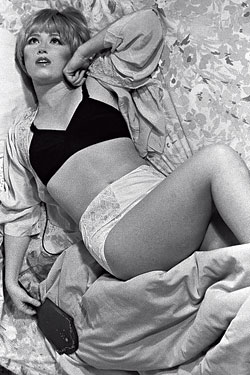
Occasionally magazines go out of business and there's little to no trace of them left anywhere. While submitting some clips today, I realized a story I wanted to submit existed only as a document on my computer, not as a link online as it should have. I wrote the story, "Mirror? Mirror. Reflections on Cindy Sherman," for the arts magazine Idee Fixe (you'll see its Facebook page hasn't been updated in over two years, but it was in fact real!) once upon a time, when it still existed, about photographer Cindy Sherman's retrospective at the Museum of Modern Art here in Manhattan. I realized re-reading it today how proud of it I am, and because of that I want it to exist somewhere on the internet so I can share it for clips purposes. So here it is.

Mirror? Mirror.
Reflections on Cindy Sherman
By Elyssa Goodman

A sword-wielding female in a purposely ill-fitting bodysuit whose misshapen breasts hang like sad pillows; a proud dancer in a feathered tutu; a flower leotard-clad juggler in an awkward nude bodysuit; a lord-like male figure in burnt orange robes; and a stern brunette woman in a 1970s-era hostess gown. Each of the characters is completely different yet, somehow, completely the same. They are all Cindy Sherman.

“She just takes pictures of herself?”

A young chick says to her beau as they stroll behind me. She is wearing a leather jacket, skinny jeans, black boots and hoop earrings. Her hair hangs unnaturally straight on the sides of her head, the result of straightening one too many days in a row. The boy is tall and lanky, wearing a too-big baseball cap embroidered with something hip, the brim pushed up and away from his dark eyes.

I have never seen Cindys so big. Towering up the sharp white walls of New York’s Museum of Modern Art, the array of 24-foot high Cindy Shermans in a variety of costumes have been printed on immense sheets of PhotoTex adhesive fabric then stuck to the walls of the museum as a mural. It is the first time the mural, created in 2010, has appeared in the United States. It lines the entrance to Cindy Sherman’s career retrospective, on view at MoMA until June 11, 2012.

“I dunno. I guess?” He shrugs.

And, to be fair, upon first glance that is exactly what it looks like. It begs one to ask, what makes you so great, lady?

From Untitled Film Stills, 1977-1980
For 35 years, Sherman has been experimenting with identity, gender construction, and perception, developing characters for herself to portray then photographing herself as those personae. The characters are often based on existing female clichés—the young starlet, the aging socialite—though Sherman occasionally dabbles in male identity. She styles each character from head to toe, laboriously choosing just the right hair, makeup, clothing, jewelry, and facial features (in a recent documentary, she was shown to have a drawerful of prosthetic noses, among other prostheses and accoutrements, all meticulously catalogued in a filing cabinet-like system of drawers).

While she is perpetually the model, a factor some would say makes her work borderline narcissistic, she is never actually the subject of her photography, which negates the aforementioned criticism. For even when Sherman produces characters who pose in various stages of nudity, the exposed parts are always false ones. What Sherman is showing us in her photographs has nothing to do with her personality, her life, her anything. She is merely showing us the construction of identity as she sees it. The result is an adventure in the grotesquerie of human identity, in which we’re asked to question the choices we make in who we say to the world we are.

While she has no pretense of self-analysis, we never do lose the visual that the created person in the image is a figure she wears upon her body. In each image, whether she is a bedraggled 1960s art-film heroine (a la her majestic Untitled Film Stills series) or a Technicolor clown, we always recognize the tell-tale almond eyes and oval face that lets us know we are looking at a Cindy Sherman photograph. We are not asked to believe her characters are real, but rather that a similar likeness exists in the world. And by constructing each identity and wearing it upon herself, she is almost saying to us, “If I can create you, you must not be as real as you think you are.”

Because nearly all of Sherman’s work involves the portrayal of female tropes, she simultaneously comments on gender identity, calling into question the artifice of female presentation. Heavily lined eyes, skin colored orange to reflect fake tanning, sagging prosthetic breasts with absurdly large, pepperoni-like nipples, corsetry and lingerie of all kinds, high-fashion suiting, and much more all feature in Sherman’s portrayals of various types of women. As if to say, “Look at all the funny things women do and are. See how weird they look? Yet they still do these things, visually altering themselves for approval. Why?” Her goal is less to answer the question than to call it into the collective consciousness—why does the issue exist at all?

It’s clear Sherman takes great risk in exploring these themes decade after decade. Not only could it come across as ‘shtick’ by now, but a typical audience isn’t usually too comfortable with having its morals and identity questioned, certainly not on as regular a basis as Sherman does. Developing her work solidly, though perhaps not purposely, in the height of the second-wave feminist movement, Sherman’s work could have easily gotten lost in the shuffle of feminist art and critique the era produced. Her inquisitiveness and thereby her work in general could have easily gotten stale ages ago, resulting in indifference, but Sherman continued, and still does continue, to find new ways to explore identity and captivate her audience. Risking an oversaturated market of feminist-related work, indifference, and ‘shtick’ criticism, she has by now probably earned herself the equivalent of several Ph.D.s in identity studies. Not to mention a nuanced body of work that continually challenges visual and psychic perception.

Sherman used herself as a vehicle for analysis beginning while she was a student at Buffalo State College in upstate New York. One project, displayed at the MoMA retrospective, was a stop-motion film entitled “Doll Clothes” from 1975. In it, Sherman made a photo cutout of herself into a paper doll and used it to tell a story of identity through the clothing the doll donned. The rest of her career has essentially been a growth and re-imagining of the ideas initially explored there.
Toward the beginning of the exhibition, a frame full of small, hand colored black and white photographs show the artist transitioning from one character—a bespectacled, short-haired woman in a flannel shirt, her face wiped clean—to another—a 1970s cabaret glamazon complete with facial stars, dark lipstick, short, windswept hair and a dark choker—by changing just one facial feature or accessory in each photograph. We see her beginning the search, trying to understand what makes two people so completely different but still so closely linked.

Not long after this particular series was completed, Sherman began working on her aforementioned, groundbreaking work Untitled Film Stills (1977-1980), also on display at MoMA. In this black and white film series, Sherman takes on 1960s B-movie and art-film heroines, from the barely-dressed bombshell to the mad housewife to the stern and ambitious career girl. All are artfully orchestrated not just with Sherman’s signature self-styling but with camera angles befitting the project’s title. She is the director of films that do not exist. Each photograph seems vaguely familiar and upon first glance may even invite the viewer to guess what films are being duplicated. In actuality, each image is an amalgam of cultural detritus, a view of women so consistently portrayed that it’s embedded in our visual consciousness and thereby instantly recognizable. Sherman asks us to recognize this, placing us in the image while simultaneously checking us out of it (in some of the photographs we can even see her pressing the remote shutter on her camera).

These are factors that have been present throughout Sherman’s work since the Film Stills series. As Sherman began experimenting with color film and later digital color photography, the ideas have gotten bigger and richer, leading her to experiment with an added layer of reality the vibrancy of color provides. Also on display at MoMA is her ‘Centerfolds’ series from 1981, commissioned by Artforum magazine. ‘Centerfolds’ was completed not long after the Untitled Film Stills and is an all-color series playing with an alternate idea of women as centerfolds in men’s magazines. Instead of oozing sex, excitement, and arousal, Sherman’s centerfolds are pained, nervous, anxious, worried and pensive, all brought more vigorously, and unsettlingly, to life in color.

From Centerfolds, 1981
In 2008, as Sherman herself began to approach middle age, her experimentation with identity took on a new direction as she created a series of aging society matrons. Produced at the height of the economic bust in the United States, the formality and elegance with which these women lived their lives had all but disappeared, and they were left living as mere relics of time gone by. Sherman assembled their identities in regal satin or sequined ball gowns, standing against lush backdrops. Wrinkled and coiffed, tucked and pulled (or all four), these characters had done their best to keep up with the changing times but hadn’t succeeded. Considered a recent triumph, the series suggests the ease with which not just older generations but older women are tossed aside in favor of the new and fresh, how youth and beauty seem to be all that matters.
Sherman’s area of artistic study is neverending. While some have attempted such gender and identity studies, there are few, if any, artists who bring the ideas to fruition as clearly as she does. And as long as there are people, there will be people for Sherman to analyze in her work, be they Hollywood wannabes, society matrons, country singers, high fashion glamazons, starlets, clowns, pin-ups, corpses, pop stars, ingénues, or even artists.

Tuesday, June 19, 2012

Let me tell you about this thing called OXHEART.

There is a thing we are all searching for in New York, and that thing is community. A group of people like us who just ‘get it.’ Our crew, our group of lovers who blend perfectly with our selves and finish the sentences we’ve only just begun. I had it in college, and truly believed that eventually it would pop up here in New York. I’m proud to say, finally, it has.

OXHEART started with Bryn Larson, in a bar on the Lower East Side, the same night I heard Iced Ink for the first time. OXHEART was to be a new arts and music collective, a party, an event, a happening, a place where people could meet and share what they create, be it music or art. I didn’t know who this very happy tall, blonde woman was, but she was instantly welcoming. As if to say okay, I like you, we’re friends now. Done.

Two weeks later, we gathered for our first OXHEART meeting. I was brought in to do any and all things words or media. Ideas flowed, decisions were made, meeting times were chosen, roles were discussed. Though the lineup of OXHEARTers later changed, four original members remained and, frankly, we’re all the better for it.

In just three months, we had it all—a venue, artists, musicians, and it all was coming together. The Gowanus Ballroom was by day Serett Metalworks, a sculpture and metalworking space right next to the Gowanus River in Brooklyn. Gorgeously high lofted ceilings were swept through with beams, brick walls painted white, a sheen of beautiful dirt and use running across the floors. It was a venue that held many art shows, and they knew how to hold ours as well.

Artists rolled in courtesy of friends, connections, and reaching out to various schools and even strangers. It is mindnumbing to think so many people have the opportunity to call themselves ‘artist’ and have it truly mean something. But I think Bryn always knew that. A lady who appreciates people who do what they love, she wanted a way for them to get exposure, to have the beauty of their work seen by others. I believed in her vision and happily worked, as we all did, without pay. The lady worked tirelessly, as did Tech/Design Hombre Mike Krenner, myself, and Photographer Carlos Henriquez, within our own OXHEART roles. The motivation came from the spirit of doing something bigger. It wasn’t about the money now. It was about showing something beautiful and creating a community of people who all thought in the same ways.

**

 Fast forward to Friday, June 15 at 9am, the day of OXHEART’s first show, “Letter Red.” I hauled myself out of bed at 7am (I’m a freelancer, cut me a break), threw on my art-hanging clothes, and made the trek to Brooklyn. Arriving, I saw all of the metal working equipment still had to be put away. The floor had to be swept, seating to be arranged, the bar to be set up, all of the art to be hung. I tried forcing myself to relax but had trouble unfurrowing my brow. After a while, though, the kind gentlemen at the Gowanus Ballroom had cleaned everything and hidden it away. I had a quick lesson in hanging artwork and how to hammer nails properly so I did not stand idly by. I ran around greeting artists and assembling wall spaces, as did Bryn and the volunteers helping that day. By noon I was still terrified, but more art was getting hung. By 4 o’clock, my body ached and, though there was more art on the walls, I was becoming unpleasant and I took an ibuprofen and chased it with beer. I was speaking in loud, angry tones. If I didn’t leave, I would have become even more vile, so it was time to go. I got home, took four Advil, got in the shower, got dressed and ate a sandwich. It was 6:30. Time to go back to Brooklyn.

Uncrumpled and no longer a ticking time bomb, I sat calmly at the front desk at the venue and people began to trickle in. They looked appreciatively around at the artwork we had all hung. I heard cries of “Wow, this is incredible!” and “Whoa, cool!” In those instances, I knew everything was worth it. Throughout the evening I was able to circulate upstairs and watch people listening to the bands with rapt attention, holding up their iPhones to take pictures of the aerialists and firebreathers, climbing in the on-site treehouse. We had done it.

“When are you having your next party??” people asked me as they left. “Sign me up!”

Riding the high of an evening well done, we hung out at the venue long after the party ended, dancing and jamming and drinking. I took my shoes off and my feet were covered in dirt and it was brilliant. Bright, sunny energy and love echoed through all of us (The second night was just as successful). This is what it was all about. At the risk of sounding like an '80s coming-of-age-flick, my life is truly changed. I don't know what will happen next with OXHEART, I don't know what the future holds, but I know I just want to keep helping throw these parties as long as possible. Let's just do it, and think about how impossible it seems when we're done. 

If you’re interested in learning more about OXHEART, visit us online at oxheart.net, check us out on Facebook at facebook.com/oxheartnyc, or follow us on Twitter at @oxheartnyc. Our OXHEARTs hug you. OXHXO.

Saturday, December 10, 2011

Taylor Mead

A thin, curlicue of a man hobbles to the stage at the Bowery Poetry Club, his cane thumping quietly along the floor. He climbs onto the stage and arrives in his seat, at a small table topped with an even smaller stereo. He pulls the microphone toward his face, obscuring it almost entirely. A bright blue New York Rangers beanie hangs on to his head for dear life, his large glasses resting beneath his beady eyes. And then he talks and talks about nothing in particular.

“None of my affairs are secret. That’s why the Guggenheim won’t give me an award,” he says in a high-pitched but gravelly voice that gets choked every so often by a ball of saliva in his throat.

He is Taylor Mead, a downtown New York legend, an actor known for his performances in independent  and experimental films from the 1960s (when the independent/experimental film movement as we know it today was just beginning) as well as in the films of Andy Warhol, where he was one of the famed Warhol Superstars. Mead is also a writer of things poetry and non-poetry, which is actually how he first made his mark on the 1950s/1960s counterculture. He and his work are considered to be an important link between the Beat Generation and the downtown New York art and theatre culture which arose around the same time. At 86 years old, Taylor Mead still performs at the Bowery Poetry Club every Monday night for exactly 30 minutes, courtesy of Bowery Arts and Sciences.

He reads poetry. “Now I’m going to read some Emily Dickinson for no reason at all except I can’t understand her….She’s so difficult she must be a genius.”

He talks about seeing Marlon Brando in A Streetcar Named Desire on Broadway in the 1950s.
“His sweat dribbled down the walls of the theatre.”

He reads what he calls a “William Burroughs random choice,” from the back of an old, crumpled mimeographed flyer, the front of which reads ‘The Taylor Mead Show featuring Richard Hell,’ a famed New York musician who is said to have coined the term ‘punk’ in the 1970s.

He tells what he calls ‘a fairy tale,’ pressing play on the tiny stereo to release a fury of chaotic jazz into the microphone as he flips through a series of nonsensical and even primitive drawings in thick black ink, tossing the pages to the floor. He reads, “Nuns operate sex factory out of convent” and “Here’s a guy masturbating. It has nothing to do with the fairy tale.” I laugh out loud. 

Unfortunately, very few people laugh with me. Seated behind long white plastic tables, they’re waiting for bingo to begin at 7pm, hosted by well-known drag personas Murray Hill and Linda Simpson. While Mead speaks, they’re talking, texting, eating sandwiches brought in from outside. They look at each other and raise their eyebrows, wondering who is this little old man telling dirty jokes onstage. I want to tell them to stop and listen, even just for a little while, to give him a chance instead of dismissing him entirely. I wouldn’t have known about him at all, either, if it wasn’t for Penny Arcade who said he was a genius and I should go see him. Before I get a chance to say anything, though, he opens his own mouth.

“THIS ISN’T BINGO SHMINGO. SHUT UP.” And they do.

He continues. “Is it time for my dirty poem yet?” he asks the man in the sound booth.
“Yes, I think it is,” the man says, his voice full of appreciation and good humor.

Mead begins to read, saying the poem was lovingly plagiarized by Allen Ginsberg. I am agog that he can even utter such a relationship in a sentence, but I try to listen anyway.

“A whispering rapist roundabout midnight…”

 But before he finishes people begin talking again and he stops reading. “Oh fuck it, it’s too dirty,” he says. Shortly thereafter he hobbles offstage and sits in “his spot” at the edge of the bar. A beer is there waiting for him.

I go and sit with him. I don’t really know what I’m going to say when I first sit down, but then I ask about the poem he was going to read. “It’s my dirty poem,” he says. Sometimes the audience listens and sometimes they don’t, he says. Tonight, though, they weren’t worthy of his poem. He chuckles quietly. “Maybe it’s because of Christmas.”